Rummy Online Guide: 13-Card Melds, Pure Sequences & Deadwood Math
Unlike pure-luck card draws, 13-card Rummy rewards sharp pattern building—once you lock in your mandatory Pure Sequence, every discard choice matters.
TL;DR Key Takeaway
Online 13-card Rummy uses two standard 52-card decks plus printed Jokers. To make a valid declaration, you must arrange all 13 cards into valid Sequences and Sets containing at least two Sequences—one of which MUST be a Pure Sequence (three or more consecutive same-suit cards with no Joker substituting).
If you enjoy thinking two moves ahead rather than watching a single card flip in 20 seconds, 13-card Rummy online is the most strategic card table in the Bangladesh lobby. Played across South Asia for generations, online Points Rummy and Pool Rummy pit your hand-building speed directly against other players—meaning disciplined decisions steadily cut down deadwood points over time. Still, beginners lose unnecessary BDT early when they confuse a Pure Sequence with an Impure Sequence, hold onto high-value Face cards too long, or forget when a 20-point First Drop saves far more Taka than riding a hopeless hand to an 80-point defeat. This walkthrough unpacks every rule of 13-card Rummy clearly, from wild cut-joker mechanics to exact BDT point calculations.
The Two Non-Negotiable Rules of 13-Card Rummy
Every player starts with 13 cards drawn from two shuffled 52-card decks (plus 2 printed Jokers, 106 cards total). On each turn, you draw one card from either the face-down Closed Deck or the face-up Open Discard Pile, then discard one unwanted card.
Your goal is to group all 13 cards into valid combinations before anyone else declares—leaving zero ungrouped 'deadwood' cards (except your 14th card, which goes into the Finish Slot to declare). Every valid hand must satisfy two strict checks:
First, you need at least two Sequences (runs of 3 or more consecutive cards of the same suit). Second, at least one of those Sequences must be Pure—meaning every single card is natural with zero printed or wild Jokers filling gaps. Note that a printed Joker or wild Joker CAN sit in a Pure Sequence only if it naturally matches its printed rank and suit (for example, 6♠-7♠-8♠ when 7 is the wild rank—that still counts as Pure!).
| Meld Type | Valid Example | Invalid Example (Trap) | Mandatory Count | Beginner Notes |
|---|---|---|---|---|
| Pure Sequence | 5♥ 6♥ 7♥ (or A-2-3♣) | 5♥ 6♥ PJ (uses Joker) | Minimum 1 required | Must finish this first before chasing sets |
| Impure Sequence | 8♦ 9♦ PJ (or J♠ Q♠ 2♠*) | 8♦ 10♦ PJ PJ (gaps need order) | At least 1 more seq | Uses Printed Joker (PJ) or Wild Joker (*) |
| Valid Set | K♠ K♥ K♦ (3/4 diff suits) | K♠ K♥ K♠ (duplicate suit!) | Optional after 2 seq | Max 4 cards; never repeat the exact same suit |
| Ace Wrapping | Q♠ K♠ A♠ or A♠ 2♠ 3♠ | K♠ A♠ 2♠ (no wrap-around) | Counts in Sequences | Ace works high (Q-K-A) or low (A-2-3), not both |
Printed Jokers vs Wild Cut Jokers Explained
Beginners often look at the face-up card tucked sideways beneath the Closed Deck and wonder why it sits there. That card is the Wild Cut Joker for that single deal. Suppose the cut reveals the 6♣. For that entire round, every 6 in the deck—6♠, 6♥, 6♦, and 6♣—turns into a wild card!
What happens if the cut card happens to be a Printed Joker itself? Under standard rules, all Aces automatically become the Wild Joker for that deal. Because both Printed Jokers and Wild Cut Jokers carry 0 deadwood points, never discard a Joker onto the open pile—unless you already have 13 cards locked and just drew an extra Joker you cannot use.
How Points Rummy Scoring Translates into BDT (৳)
In Points Rummy, every point carries a fixed Taka value chosen before joining the lobby—for example, ৳1/point, ৳2/point, or ৳5/point. Because the maximum possible penalty per hand is capped at 80 points, you must enter a ৳2/point table with at least 80 × ৳2 = ৳160 in your wallet.
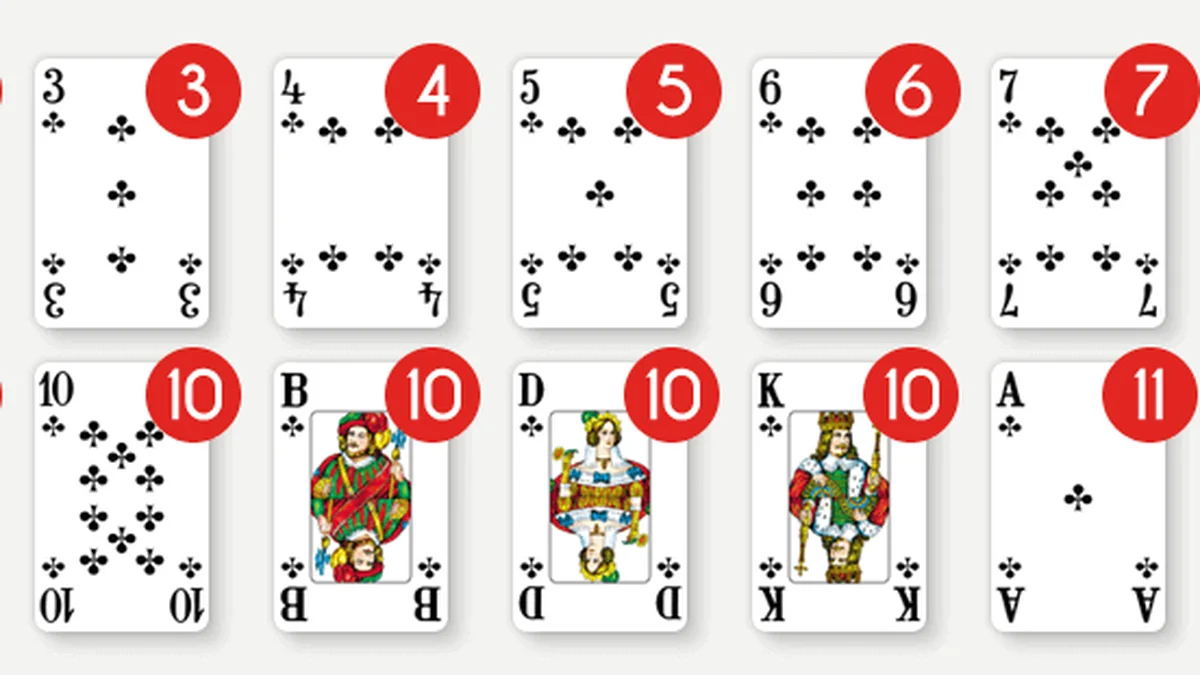
Point values are straightforward: numbered cards 2 through 10 count at face value (a 7♠ equals 7 points), Face cards (J, Q, K) and Aces all count as 10 points each, and Jokers count 0 points. Notice how quickly unmelded Face cards pile up: holding an ungrouped King, Queen, and Ace already leaves you with 30 deadwood points.
When the winner declares validly, they score 0 points and collect the sum of every loser's ungrouped deadwood multiplied by the point value (minus the small platform rake). Crucially, if you already built a Pure Sequence, only the cards *outside* valid sequences/sets count against you. If you have *not* finished a Pure Sequence yet, every single card in your hand—even completed Sets—counts toward your penalty up to the 80-point cap!
5-Step Beginner Decision Loop on Every Rummy Turn
Rather than randomly grouping cards by color, run through this calm five-step loop from the moment your 13 cards fan across the screen.
- 01Evaluate Drop vs Play Before Drawing
Check for Jokers and two-card sequence pairs (like 7♥-8♥). Zero Jokers + no Pure Sequence prospects = take the 20-point First Drop right away. - 02Isolate Your Pure Sequence First
Sort by suit immediately and lock at least one 3-card or 4-card Pure Sequence before worrying about Sets or Impure Sequences. - 03Shed Unconnected 10-Point Cards Early
Throw away isolated Kings, Queens, and Aces in rounds 1–3 so an early opponent declaration never catches you holding 40+ points of deadwood. - 04Hold Middle Cards (5, 6, 7, 8) Longer
Middle cards connect on both sides (6♠ links with 4-5 or 7-8), whereas an isolated 2 or King connects in only one direction. - 05Audit Your Melds Before Pressing Declare
Confirm: (1) At least 1 Pure Sequence, (2) At least 2 total Sequences, (3) No duplicate suits inside any Set, and (4) 14th card dragged cleanly to Finish.
First Drop vs Middle Drop vs Invalid Declaration
Understanding the three exit penalties separates steady Rummy players from impulsive ones. A First Drop occurs before you pick your very first card and costs 20 points. A Middle Drop occurs after you have drawn at least one card and costs 40 points. Meanwhile, losing at full showdown or clicking Declare on an invalid arrangement triggers the maximum 80-point penalty.
Let's check the BDT math on a ৳5/point table: a First Drop costs ৳100, a Middle Drop costs ৳200, and riding out a broken hand costs ৳400. If your opponent has picked two high cards off the Open Pile and you are still missing your Pure Sequence on turn five, taking a 40-point Middle Drop saves ৳200 instantly.
- Points Rummy: Single-deal quick matches settled in BDT after every hand.
- Pool Rummy (101 / 201): Players stay in until cumulative penalty points hit 101 or 201; last survivor wins the pool.
- Deals Rummy: Fixed 2, 3, or 6 deals with equal starting chips; highest chip count at the end takes the pot.
Reading Opponents Without Seeing Their Cards
Even in online lobbies, every discard tells a story. Watch the Open Pile history panel closely: if the player sitting before you picks up a 9♦ from the Open Pile, they almost certainly hold either 7♦-8♦, 8♦-10♦, or two other 9s. Avoid throwing 8♦, 10♦, or another 9 right after—you would hand them a free meld.
Conversely, if you discard a high card like K♣ and nobody touches it, holding onto a spare Queen or Jack of Clubs becomes slightly safer against immediate melds, though you should still avoid hoarding deadwood late in the round. For players who also enjoy pure probability card games alongside Rummy, compare this tactical pace against Teen Patti or Live Baccarat.
Funding & Mobile Setup for Smooth Online Rummy
Because a 13-card Rummy hand requires clear suit icons—especially distinguishing Spades from Clubs on bright afternoon screens—play with your phone brightness comfortable and disable auto-rotate lock interference. On Play6777Bet, Rummy tables run cleanly in landscape HTML5 mode with low mobile data consumption (~25 MB/hour, far lighter than live video streams). Top up from ৳200 via Nagad or bKash and stick to ৳1/point rooms until you consistently finish hands under 25 points.
18+ Responsible Gaming & Player Protection in Bangladesh
Because Points Rummy feels skill-based, losing two hands in a row to faster opponents can tempt players into moving up from ৳1/point to ৳10/point tables to 'win it back in one deal.' Remember that an 80-point loss at ৳10/point equals ৳800 instantly—always stay within your preset stake tier and take breaks after consecutive drops.
- Minimum Age Rule: Strictly for adults aged 18+. Never share mobile wallet PINs or Play6777Bet credentials with minors.
- 24-Hour Self-Exclusion: Temporary cooling-off periods and full account self-exclusion apply within 24 hours across mobile web and app sessions.
- Free Confidential Support: Seek help anytime from BeGambleAware (begambleaware.org), GamCare (gamcare.org.uk), or Gambling Therapy (gamblingtherapy.org) for 24/7 international multilingual assistance.
Summary & Next Steps on Play6777Bet
Online 13-card Rummy rewards patience, clean sequence sorting, and smart damage control. Lock your Pure Sequence first, drop weak hands early for 20 points rather than eating 80-point full losses, and monitor what cards opponents pull from the open pile. When you want to switch from peer skill play to instant studio tables, check out our Andar Bahar guide or return to the Live Casino Hub.
Frequently Asked Questions
Can I use a Joker in a Pure Sequence in 13-card Rummy?
No—you cannot use a Joker as a substitute in a Pure Sequence. The single exception is when a Wild Cut Joker naturally belongs in that exact suit and consecutive slot (for example, 5♠-6♠-7♠ when 6 is the wild rank).
What is the maximum number of points you can lose in one Rummy deal?
In standard 13-card Points Rummy, individual hand penalties are capped at 80 points maximum—even if your unmelded Face cards technically add up to 110 points.
Is K-A-2 a valid sequence in online Rummy?
No. In 13-card Rummy, Ace can connect low with 2-3 (A-2-3) or high with Q-K (Q-K-A), but you cannot wrap King-Ace-2 together into a single sequence.
What is the difference between First Drop and Middle Drop?
A First Drop happens before you draw your first card and costs 20 points. A Middle Drop happens any time after you have drawn at least one card and costs 40 points.
Can I form a Set with two Kings of the same suit from two decks?
No. Even though two 52-card decks are used, every Set must contain three or four cards of the same rank in completely different suits—never two identical cards like K♠ and K♠.